Virtual & Augmented Reality – Are They Really Worth the Hype?

Virtual Reality (VR) and Augmented Reality (AR) are slowly making their way into schools.  Depending on the quality of the needed device a VR headset can be a few dollars (i.e. cardboard cutout that uses your smartphone) or a very expensive one costing hundreds of dollars per unit.  AR headsets can be just as expensive.


I’m admittedly a bit cautious when new tech is touted as the next ‘best thing’ for education.  Are these headsets just a gimmick with lots of fun entertainment value or are they really a way for students to actually go deeper with their learning?

Like most everything, I suppose it depends on how and why you use them.

Continue reading

Consumers to Creators

We’ve all been to school.  Look at me — I’ve never left.  So, we all think we’ve got a pretty good idea of what’s supposed to happen there.

Let’s review …

One of the historical goals of schools has been to provide students with enough knowledge of ‘stuff’ and ‘skills’ to be productive citizens once they graduate.  To achieve this, students have historically been ‘consumers’ of information or content — they learned from the ‘knowledge keepers’ — our teachers.  As curriculum evolved, new courses were created, teachers learned the content and then imparted this knowledge.  Sort of the ‘sage on the stage’ kind of process.  It was pretty much a unidirectional mode of information transfer.

pexels-photo-256417.jpeg

In today’s world, there is still a need for a content expert who knows ‘stuff’ — a teacher who’s been to post-secondary and become a subject area or learning specialist.  This need won’t change anytime soon — teachers continue to be an absolutely critical component of student success.

But times are changing …

In today’s world the role of the teacher IS fundamentally changing.  Content is ubiquitous — we can find it just about anywhere on the internet in a virtual space accessible by a few clicks on your smartphone or a verbal question to SIRI.  Content no longer resides solely in the domain of the teacher.  In fact, students are often far better content masters than their teachers on any number of topics.

So, what does this mean for the traditional learning paradigm?

Continue reading

Artificial Intelligence Is Here – Time to Buckle up!

Fair warning — this blog is a little long, especially with the embedded videos.  You don’t need to actually watch the videos to understand the content, but they really do help to bring the information home.   I suggest setting aside about 10-15 minutes for this blog.  It’s long because I find this topic extremely fascinating.  You’ve been warned!
Artificial intelligence 3I entered the incredible world of Artificial Intelligence (AI) at a recent educational leadership event.  I heard from and interacted with a number of highly respected researchers, thinkers, and leaders in the world of AI.  It was a truly exhilarating learning experience.

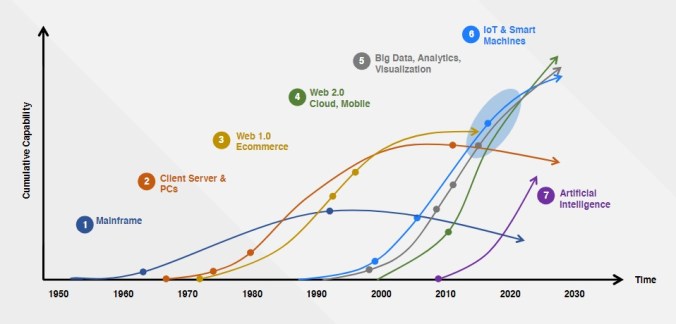
As part of the presentation, the history of computers, the Web 1.0 and 2.0, AI and a number of other computer-centric advances were graphed for us as a function of their capabilities over time.

As you can see from the graph below, the capability of individual PCs and mainframe computers are well past their prime.  However, the relatively recent presence of smart machines, analytics and big data have been gaining in strength, but are now slowly starting to level off.  Look at the purple AI line.  It’s becoming vertical — more so every year.  AI is literally exploding into our world unlike any other computer-based technology — EVER!Computers AI History graph
At times, I felt uncomfortable hearing about AI and it’s influence on our world, but I was also excited at the possibilities that lie ahead.

Continue reading