Servant Leadership

I first heard about the concept of Servant Leadership several years ago and appreciated its main ideas:
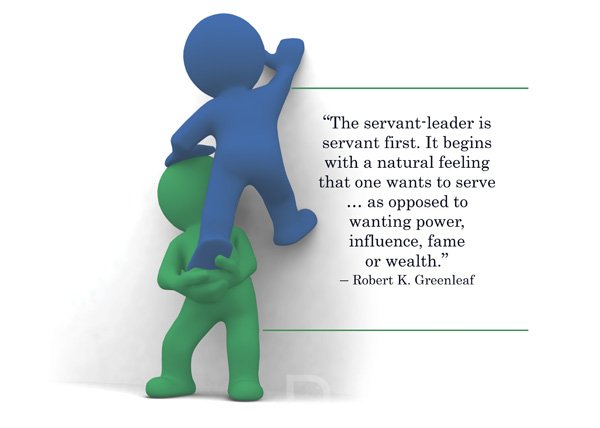
  • A servant leader is someone who “shares power, puts the needs of the employees first and helps people develop and perform as highly as possible. Instead of the people working to serve the leader, the leader exists to serve the people.”

It’s really about framing one’s MINDSET about how you relate to others in the workplace — about how one goes about their day — in other words, how a leader thinks, speaks and acts to support the people in the organization.

When I contextualize it for myself, I picture it being about my words and my actions that build the confidence, abilities and leadership in others. It’s also an area where I continually think of ways to become better.

Being part of a smaller school district, it is imperative that I lead in areas that build capacity — both in individuals and in our district. It is capacity that helps to build the redundancies in skills and knowledge which enable our district to withstand things like sudden illnesses or departures.

(More on Page 2)

Saanich Schools: Change During a Pandemic

I was recently asked to write an article for a local magazine on how we’ve managed our schools throughout the pandemic. There is, without question, a lot of anxiety from this health crisis, but what a great opportunity to share some of the positives we can take from our current situation.

There are always lessons we can learn, changes that are beneficial and momentum that we can use to instill growth. And while uncertainty can breed worry it can also be a springboard for necessary change.

You can find the article from Seaside Magazine on their website, but I’ve also reproduced it for you below.

SAANICH SCHOOLS – CHANGE DURING A PANDEMIC

It goes without saying that COVID-19 has caused some significant upheaval in the public education system – for students, parents, teachers, administrators and support staff.  Schools were closed in March, then partially re-opened with an emergency remote learning option in April, a partial opening in May and then fully re-opened in September with an optional transitional remote learning program.  All of them complex on their own with each phase requiring different approaches, different resources and different thinking — all in an accelerated timeline.

(More on Page 2)

‘Tis the Season for Hope

There’s a certain peacefulness to the holiday season. I love this time of year.

For me, it’s one where I slow my pulse rate enough so I can see and hear the beauty that surrounds us — the twinkling lights that adorn our homes and offices, the peaceful music that fills our main streets, and perhaps even a gentle snowfall that blankets our landscape creating a certain stillness.

I have fond memories of all of these things from my childhood to the present. The holiday season rejuvenates me.

But, this year feels different. Very different.

The sense in our community is one of angst — of heightened anxiety instead of peacefulness. COVID-19 has a way of doing that. It certainly makes sense. We are living in an unpredictable world. Despite all of the prognostications and charts, tomorrow is uncertain and brings a sense of apprehension.

And yet, I continue to believe in our future. I believe in the power of HOPE — the importance of looking towards a brighter tomorrow. Our collective future is built on hope.

It’s what drives us in education — the belief that our efforts will result in a better tomorrow — where our students are taught to be solution finders, creators and innovators. Every meeting we have, every decision we make is focused on building capacity and resilience in our students. What we’re really instilling in them is HOPE. Hope builds belief in oneself and others. It builds character, self-worth and inspiration.

Hope is critical. Hope is essential.

(more on page 2)