
There’s so much I am grateful for as Superintendent. But if I had to name just one thing that stands out, it’s this: I get to be part of a professional community that never stops striving to be better. Every day I’m surrounded by people who challenge and inspire me to grow — people who believe deeply in creating spaces where every learner can thrive. Together, we’re not just educators. We’re leaders. And we’re building something meaningful.
Like everywhere else, our district is affected by global issues. The global social and political realities of today are significant and impacting us in unexpected ways. In some of my previous posts I have commented on things such as the current political turmoil, economic uncertainty and social media biases — where we have seen the marginalizing of people because of their beliefs and personal preferences. I have blogged about the problems of racism, bigotry and hatred — because they are important topics for me — areas where we need conversation and action against them. As a school system, we have an obligation to combat these intolerances and be strong in our belief of being the places of kindness and understanding — the places where students feel welcomed, safe and included.

These are some of the current influences that are shaping my thinking and wonderings. With this as a backdrop, I’ve compiled a short list of 4 areas of personal reflection that I’d like to share — areas where I’ve spent some time — at work, on my drive home or perhaps walking Tucker:
- Student Success
- Artificial Intelligence & Education
- Political and Economic Upheaval
- A Personal Perspective
Student Success

We are 1/2 way through Strategic Plan 2022-2027 — and making some good progress in: Literacy; Indigenous Learner Success; Mental Health & Wellness; and Global Citizenship.
School Plans, Personal Growth Plans, Long-Range Facilities Plans, staff recruitment, the Information Technology Plan, budget planning and many other areas are all examples of how we align our efforts to the Strategic Plan, building on what we know works well as well as trying new things to make us better.
The Enhancing Student Learning Report (Sept 2024) provides a great overview of our successes and areas where we still need to focus.
Here are some sample results:
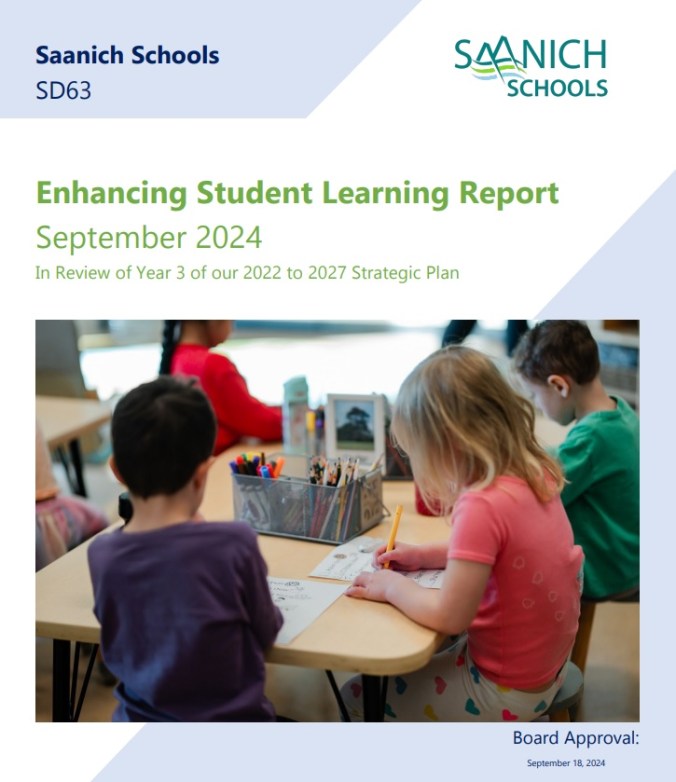
- Overall student literacy rates are showing improvement including for students with complex learning needs. There is still a difference in literacy rates between Indigenous and non-Indigenous students, but the gap is narrowing.
- Overall, students are feeling welcomed and safe at school. There has been a significant improvement of Indigenous students feeling a sense of belonging.
- It is clear that having an adult with whom every child feels connected makes a tremendous difference in students’ sense of safety, as well as feeling valued for who they are in this world.
- Graduation rates for all students continue to show a steady increase, with the biggest increase seen for the 6-year Indigenous student graduation rate increasing from 56% (2022-22) to 73% (2023-24).
These are just a few of the trends we are seeing. I encourage you to look over the entire Report when you have some time. While there is still much work to be done — especially as it relates to building equity — it is important to acknowledge the efforts our staff are providing in building successful learning opportunities for the students in our care.
Artificial Intelligence and Education
This is an exciting time to be in K-12 education.
In the words of a friend and colleague, “The AI you’re using today is the worst it’s ever going to be.” Being the most recent ‘disruptive technology‘, AI is altering the educational landscape — changing how we lesson plan, increasing accessibility to the curriculum, as well as how we assess student progress. It also provides opportunities within the business side of our system.
But, this newest of technologies also comes with questions and worries. We’re not ignoring these, but instead we’re building a foundation of understanding that is continually evolving alongside of the technology. By embracing the conversation, we have the best opportunity to leverage its possibilities, while being cognizant of ensuring its appropriate use.
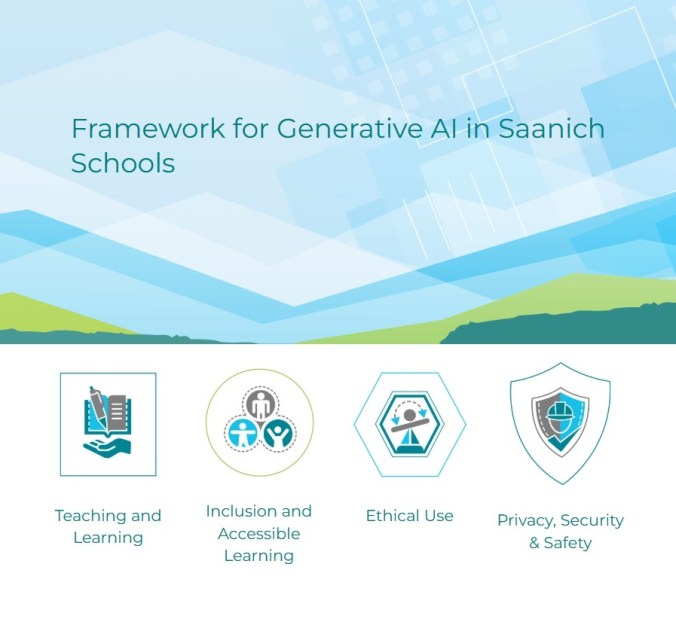
In Saanich, we produced a foundational document (Framework for Generative AI in Saanich Schools) that provides some of the ‘bumper pads or guiderails’ for AI in our schools. It is not the final word on how we use AI, but it does give us the foundation from which to build awareness and understanding, as well as increase our system capacity in capitalizing on this new, and evolving tool.
We hosted two staff GenAI Think Tanks this year as well as a virtual Parent Information Evening with 300 parents registered.
Our goal in these ongoing conversations is to share our current knowledge and progress, ask questions and continue our learning journey. We don’t have all of the answers. By asking questions and spending the time charting a path forward, we remain committed to being informed and progressive. We see the possibilities that AI can bring to our teaching and learning environments.
Stay tuned for continuing updates next year.
Political and Economic Upheaval
I have never intended for this blog to serve as a political platform—that has never been its purpose. Yet, remaining silent in the face of today’s turbulent political, social, and economic climate would be to ignore the wild uncertainty that surrounds us. This global instability is reverberating across all levels of governance — national, provincial, and local — leaving no community untouched, including here in British Columbia. Government budgets are in a state of flux, and school districts are not immune from the effects of this global uncertainty.
A Personal Perspective
Life is filled with moments that take your breath away and remind you there is a bigger picture . This past year, one of those moments was the birth of our granddaughter, Ophelia. What a pure bundle of joy! And, she just had her first birthday.

Her brightness and inquisitiveness, the pure joy when she tastes new food, the giggles when you play peek-a-boo, and the screams of delight when you blow bubbles in her neck — they all put into perspective life’s priorities.
While there are many pressure points in our professional lives — in the end, what matters most are the people.
It is Ophelia and others like her who bring the greatest meaning to our lives and our priorities — both personally and professionally.
See you in September!
For those of you returning next year, I look forward to connecting with you again in our schools and district office. And, if you are off to new adventures thank you for being part of our community of learners. I wish you well.
Thank you to everyone who has entered my world this year — you have made an impact and a difference. I wish all of you a summer of rejuvenation, and opportunities to do the things that may get pushed aside during the busy school year.
Dave
(This post was written without the support of Artificial Intelligence.)





 The Power of Why