Digital Leadership in K–12: Harnessing AI Without Losing Humanity

I still remember the thrill of moving from my trusty Brother electric typewriter to a remote computer terminal. I’d type out a paper at the University of Calgary, send it across campus to the printer station, and — assuming someone was there — I’d find my term paper neatly placed in a pigeonhole. No more whiteout, no more misaligned type. Just a professional looking report. It felt like magic.

Captain Kirk at the Starship’s Computer

Back then, the future was something we saw on TV. In the 1960s and 70s, Star Trek imagined a world where Captain Kirk could simply ask the ship’s computer a question and get an instant, logical response. That seemed centuries away.

But here we are today where artificial intelligence (AI) can answer your questions in real time, scanning vast databases for what it thinks is the best response. Not perfect — just reasonable. Still, it feels like magic.

I’ve written before about AI’s potential in school (The Sky is Falling … AGAIN, Jan 2023) — personalized instruction, student assessment, lesson generation. But it’s not just about teaching and learning. AI has the ability of transforming the business side of K–12 as well — student registration, policy or procedure inquiries, workflow improvements, even analyzing population growth trends. And that’s only scratching the surface.

THE VISION: Harness AI to improve student learning and success while limiting misuse and risk.

AI is everywhere — digital assistants, search engines, social media, online shopping, fraud prevention, gaming, medical diagnosis. The list goes on. But with this leap forward come real concerns: deepfakes, bias, privacy violations, job security, hacking, intensive energy consumption and more.

So, where do schools fit in? How do we balance possibilities with risks?

To begin, we keep asking the important questions:

  • What bias and accuracy does this AI tool bring?
  • Does it make sense to use it in a particular place? Will it improve student access to their learning?
  • How do we protect data privacy?
  • How do we preserve critical thinking skills?
  • How do we keep human connections at the center?

Actively exploring its possibilities is not only important, it’s also non-negotiable. As AI’s capabilities evolve, waiting until ‘things have settled’ is like waiting for the grass to stop growing before you mow it. You might as well start now, because it’s only going to get more difficult the longer you wait.

We’ve done this before. Think calculators. Think the internet. Both were disruptive. Both raised concerns. Yet we found ways to integrate them without losing the essence of learning. Calculators didn’t erase math skills. The internet didn’t destroy originality — plagiarism existed long before Google. We adapted. We can do it again.

My point here is not to minimize the real and potential risks of AI — they are there — but, instead to chart a path of exploration that can maximize its advantages while minimizing the risks. Yes, there are bigger challenges with AI than with the calculator and the internet — primarily because AI is evolving so quickly, and we don’t know what next month will look like, let alone next year. Yet, it’s potential for improved access to curriculum, personalizing the educational experiences, building student success, and enhancing the business side of education is unparalleled.

Why AI Matters for Kids’ Brains

Can technology actually help our kids’ brains grow? Yes, if we use it wisely.

Here’s the good news — AI can be a powerful ally for brain development. AI can personalize learning, offering challenges that match a child’s pace and providing instant feedback. Research shows this supports executive functions like working memory and cognitive flexibility. When used wisely, AI can help teachers focus on what they do best — inspiring curiosity and connection.

But here’s the catch — too much automation can strip away the human connection that fuels motivation. Brains aren’t just processors — they’re social organs. Kids need eye contact, laughter, and human connection. Schools are where this happens. When I ask students what’s working for them, they never say “the technology”. They talk about teachers, administrators, counselors, educational assistants—the people who connect with them on a daily basis.

Human connections build confidence, understanding and competence — technology is a tool, not the teacher.

Of course, every shiny tool has a shadow. Over-reliance on AI can lead to passive learning, reduced creativity, and data privacy concerns. AI algorithms aren’t perfect — they carry biases that affect their output, so teaching about these potential biases help us manage how and where we use the tool.

So, what’s the solution? Balance.

Digital leadership means creating guardrails so AI enhances — not replaces — the human elements of learning. Think of AI as the sous-chef, not the head chef. It can chop the veggies, but the teacher still crafts the recipe. In Saanich, as part of our own guardrails we developed an Artificial Intelligence Framework built on four themes:

  • Teaching & Learning
  • Inclusion and Accessible Learning
  • Ethical Use
  • Privacy, Security & Safety

What Can Parents Do?

You don’t need a tech degree to stay involved. Encourage screen-time boundaries. Promote activities that build executive function outside of the tech world — things like puzzles, outdoor play, and storytelling. The best brain development happens when kids combine digital learning with real-world experiences — with trusted adults being the glue and the motivation.

AI in education isn’t a villain or a superhero — it’s a tool. In the hands of thoughtful leaders and engaged parents, it can help kids develop the cognitive skills they need for a complex world. But, we’re also not losing sight of the human heartbeat in learning.

Because, no algorithm can replace the magic of a teacher who believes in your child — or the joy of a parent cheering them on.

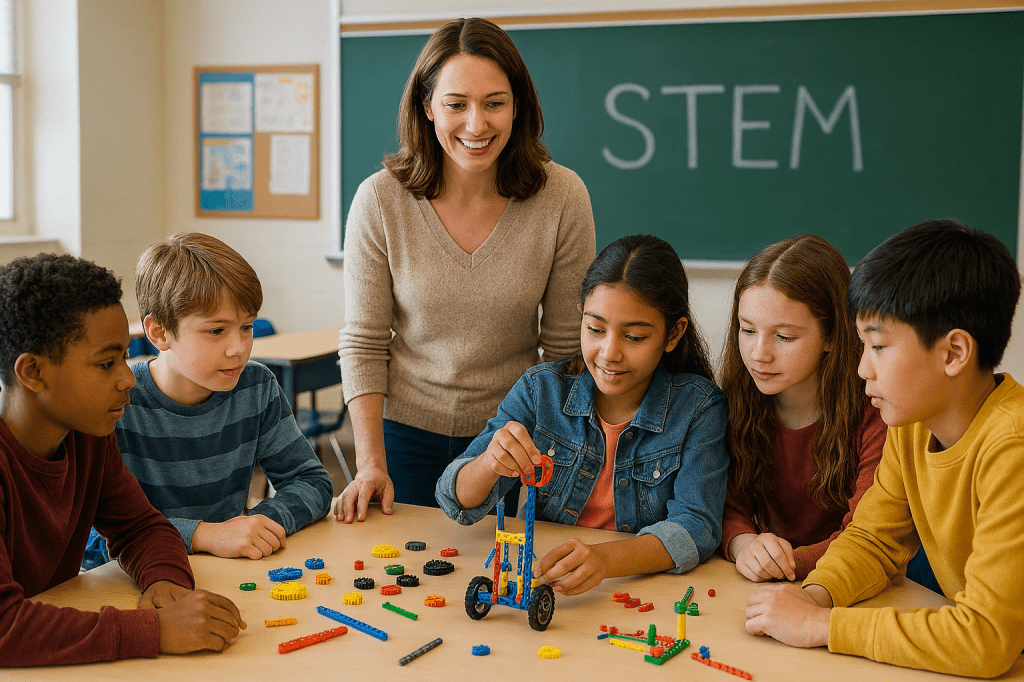
(This post was written by the author. AI created some of the images as well as reviewing the post for flow and grammar.)

The Neuroscience of Nostalgia: Why Familiar Stories Feel So Good

I’m fascinated by the exploration of brain function and, specifically, how it relates to education and student success. Neuroscience continues to be a great source of information for building an even better education system.

Before I begin my post on The Neuroscience of Nostalgia, let’s begin with talking about one of my favourite TV shows – M*A*S*H. I’ve watched the series at least 10 times over — probably more.

Why do I watch the same episodes again and again and again?

My ongoing commitment to this 1970s wartime sitcom is not because I’m bored or because I’m too lazy to watch something new — I watch them because they’re familiar. I can predict what’s coming — even knowing many of the script lines. There are no surprise endings. No plot twists. Just dry humour, heartfelt moments, and a sense of comfort in knowing everyone on the TV screen.

And, as it turns out, there’s strong neuroscience behind the importance of this familiarity.

When we rewatch a familiar show, listen to a favourite song, or read a treasured bedtime story to our children, our brains breathe a sigh of relief. The amygdala — the part of the brain that scans for danger like a hypervigilant squirrel — gets to take a break. It recognizes the storyline, the characters, the music. There’s no threat. Just Corporal Radar O’Reilly trying to keep the M*A*S*H camp running smoothly. 

This is what neuroscientists call comfort-watching — something that reduces one’s cognitive load. Your prefrontal cortex — the part of your brain responsible for planning and decision-making gets to rest. When you comfort-watch (or comfort-listen or comfort-read) you already know what happens next. There’s no need to analyze, predict, or problem solve — you just relax and take it all in.

Science has shown that there is a fundamental need for our brains to find that ‘relax mode’ — to not worry about what might be coming next.

A 2012 study found that rewatching familiar shows helps people feel soothed, restored, and emotionally grounded. It’s not about entertainment—it’s about emotional safety. Another study showed that people turn to familiar media when they’re emotionally drained because it provides a sense of control and predictability.

So, how does comfort-watching, or comfort-listening or comfort-reading relate to the classroom? Think about why children insist on hearing the same story over and over again.

Why do Kindergarten students want to sing the same song every morning? It’s not because they lack imagination. It’s because their developing brains crave predictability. Neuroscience shows that repetition strengthens neural pathways, helping children process language, emotions, and cause-and-effect relationships.

Star Wars – My Movies of Choice

There were reports that during the 2020 pandemic that large numbers of people turned to their childhood TV shows and movies. When surrounded by the unknowns of the pandemic, people found themselves surfing to find series or movies that were familiar. When the world feels chaotic, our nervous system reaches for what’s known. Predictable stories act like a buffer between us and the unknown. They bring order to chaos.

And for our students — especially those navigating big emotions, new environments, or transitions — familiarity is a powerful form of regulation.

This is why school routines matter.

Morning circle time on the carpet for Kindergarten students, consistent classroom expectations, emotionally safe spaces where a dysregulated child can surround themselves with familiarity — and, yes, even Pizza Fridays — all help students feel grounded. When we create predictable environments, we’re not just managing behaviour — we’re supporting brain development.

Radar and Hawkeye from M*A*S*H

So, don’t despair when a child seeks familiarity. Think of it as their brain ‘taking a breath’ to become centered. Their brains are doing exactly what they’re wired to do — seek safety through familiarity.

And if you find yourself rewatching M*A*S*H, Friends or Star Wars after a long day, know that you’re not being lazy.

You’re self-regulating. Neuroscience says so.

Why Equity and Excellence Must Walk Hand in Hand: Lessons from Finland and British Columbia

In education, we often look outward to learn inward. For years, Finland has been a guiding light — its public education system admired globally for its innovation, student success, and deep commitment to equity. Researchers, policymakers, and educators have studied it closely, hoping to understand how a small Nordic country became an educational superpower.

But Finland is no longer alone in this spotlight.

British Columbia has quietly — and confidently — joined the ranks of the world’s most respected education systems. Our province has consistently performed at the top of international assessments, and in 2019, the OECD chose BC to host its Future of Education and Skills 2030 meeting — the first time this global gathering was held in North America. That moment wasn’t just symbolic. It was a recognition of the work we’ve done together: educators, families, and communities building a system that values both excellence and equity.

Yes, we’ve learned from Finland. But, we’ve also forged our own path.

One of Finland’s most influential voices, Professor Pasi Sahlberg, has long championed the idea that public education must be both excellent and equitable. Currently a professor of Educational Leadership at the University of Melbourne in Australia, Sahlberg has worn many hats — teacher, researcher, policy advisor — and through it all, he’s remained steadfast in his belief that education is a public good. He reminds us that schools are not just places of learning; they are pillars of democracy, equity, and opportunity.

His message is clear: we don’t have to choose between high achievement and fair access. We can — and must — pursue both.

Here in Saanich, we see this every day:

  • In classrooms where students are encouraged to think critically and creatively.
  • In schools where staff work tirelessly to ensure every learner feels seen, supported, and challenged.
  • Where we recognize that Indigenous students are not achieving to the same level as their non-indigenous peers and, as such, continuing to focus on this inequity.
  • In families and communities that partner with us to nurture not just academic success, but well-being, belonging, and purpose.

The work is not easy. But it is essential.

As we look ahead, let’s continue to ask ourselves these questions:

  • Are we creating spaces where all students can thrive?
  • How do we continue to value our educators and support staff as the professionals they are?
  • Are we building a system that reflects the diversity, complexity, and potential of every learner?

Equity and excellence are not opposing forces. They are twin pillars of a strong public education system. And when we commit to both, we create something powerful — not just for our students, but for our entire community.