The Critical Need For Gratitude

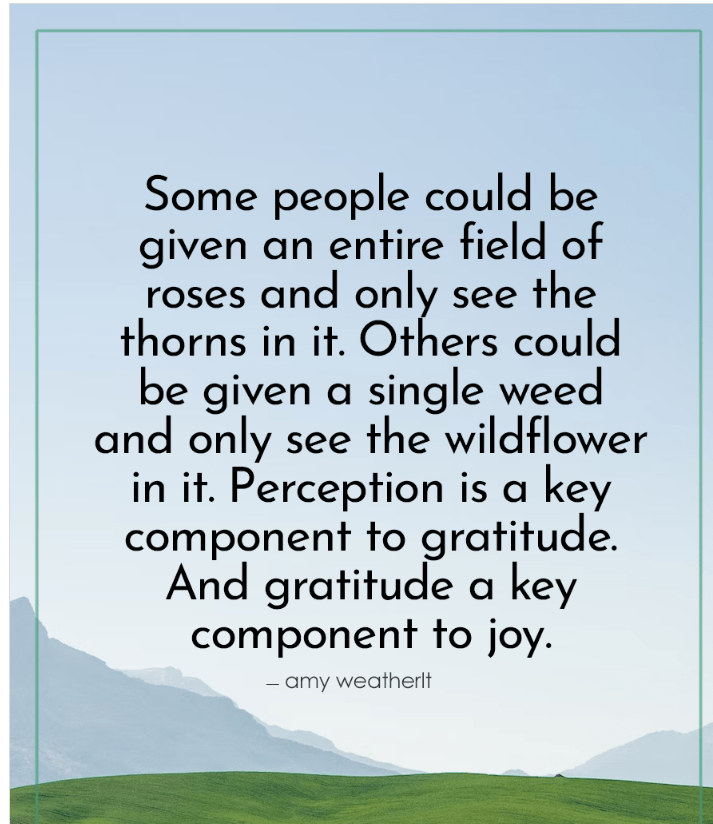
There’s too much anger and finger-pointing in our world — so much blaming of others — especially these days.

Some people and communities are definitely more fortunate than others — I have many things that others do not.

If we all took a bit more time to practice gratitude — for both the big and little things — I’m pretty sure our world would be a better place.

That’s all.

Reality – More than the Facts

I’ve been doing a lot of recent wondering about the large amount of loud, social media noise that is crowding out more rationale thoughts and ideas. Part of my musing is how the education system should be responding to it in a way that builds a capacity in students to be able to discern truth from fiction — facts from opinions.

Let me go back a few years to my late teens and early 20s.

My undergraduate training in science provided me with an excellent set of tools to understand the world — to find reasons or explanations for a lot of things:

  • Why is the world’s climate changing so quickly?
  • What happens to our brain when we read?
  • What does trauma do to a person’s ability to learn?

Science uses The Scientific Method which, at its heart, is about ‘careful observation coupled with rigorous skepticism‘. Science uses a systematic process of working to disprove a current understanding about something, until the overwhelming evidence points to the truth — to an accepted fact.

I also love that science remains open to being wrong — that it challenges our assumptions and beliefs to ensure that bias is not part of the explanation.

REALITY IS MORE THAN FACTS

Yet, as I’ve grown in my career and throughout life, I’ve also come to understand that the ‘black and white’ world of science is not the complete answer. Reality is a combination of both the facts in front of us, and our personal experiences — experiences that help to create the context surrounding the facts.

Context: The conditions or situations that give meaning to an event.

Context adds the colour to the ‘black and white’ world of facts. The reality that we each experience lies enveloped in our own personal history and context.

  • How is one’s own personal history influencing the event of today?
  • What inherent biases are people bringing to what they ‘see’ or ‘hear’?

By taking the time to understand the ‘tapestry’ or colour of the situation you can start to forge a deeper understanding of what lies before you — helping you create a better solution to whatever problem or situation exists.

So, what do context and our own history have to do with public education? I’m glad you asked!

CRITICAL THINKING

If a goal of public education is to ‘have educated citizens who thrive in a changing world’, then preparing them to be critical consumers of their world is essential. Students need to be able to understand more than facts — they need to be able to examine the context in which they observe these facts and be aware that a person’s own history and perceptions may be affecting their understanding.

Critical Thinking is an absolute necessity for our students to be the citizens we need in a world filled with fake news, social media bias and opinions camouflaging as fact:

BC Education: Critical … thinking encompasses a set of abilities that students use to examine their own thinking and that of others. This involves making judgments based on reasoning, where students consider options, analyze options using specific criteria, and draw conclusions.

Sounds great. We want students to critically examine the information before them, ask relevant questions and move their understanding forward.

But, can we objectively measure Critical Thinking? Should we even try?

It’s not like you can easily put a number beside Critical Thinking to see if it improves over time. And, because something isn’t easily measured, it doesn’t mean it isn’t important — As examples, Character, Integrity and Honesty are three traits that I would argue are very important but aren’t easily measured.

Several cognitive experts set out to come to an agreed definition of Critical Thinking at a Learning and the Brain conference. And to save you the time of wondering … No agreement was reached. In fact, they disagreed on a number of issues surrounding the concept.

Curiosity Leads to Thinking Critically

But, here’s some of what they did agree on about Critical Thinking …

  • Although we can’t agree on a common definition, that doesn’t mean we shouldn’t prioritize Critical Thinking in education.
  • True critical thinkers aggressively question their own beliefs.
  • Teaching to think critically about something should be done as early as Kindergarten.
  • Asking questions about a topic is the necessary first step to a deeper understanding.
  • Be careful in the assumption that students are not already thinking critically, especially if we know that it can’t be easily measured.
  • Critical Thinking is important — but so are Creative Thinking, Interdisciplinary Thinking, Systems Thinking, and Fuzzy Logic to name a few.
  • So, don’t start a Critical Thinking Program in schools — that isn’t necessary or reasonable.
  • Instead, schools should focus on the importance of Curiosity being present. Being openly curious is the path to understanding.

FINAL THOUGHTS

Here are my top 5 take aways to help students be well prepared in distinguishing reality from what is not reality:

  1. Challenge assumptions – don’t assume what you’re observing is accurate,
  2. Watch out for opinions that may be misrepresented as facts – social media is flooded with this reality,
  3. Be reflective on your personal history and bias – it’s more influential on you than you may think,
  4. Be open to being wrong – I’m wrong a lot and admitting it actually helps me move forward, and
  5. Always be curious — because curiosity leads to deeper understanding!

That’s a pretty good list.

  • Science gives us a foundation;
  • Critical Thinking can lead to understanding context and its impact on the facts; and
  • Students become better, more informed citizens.

Important concepts in a world of uncertainty, hyperbole and unsubstantiated opinions. And there’s no shortage of that these days.

The Teenage Brain: A New Perspective

The teenage years have always been a big adventure — a time of seemingly boundless energy and enthusiasm. There has also been a tendency to sometimes label the teenager as impulsive and reckless — risk-takers who lack the decision-making abilities of adults.

The Wonderfully Complex and Morphing Brain of a Teenager

This characterization is misleading as recent neuroscience research is flipping this narrative on its head.

In an article by Zara Abrams, “What neuroscience tells us about the teenage brain” (2022), it turns out that the teenage brain is not just a bundle of chaos heading towards risky behaviour, but a powerhouse of neural potential and adaptability.

Here are some recent findings …

One of the most fascinating aspects of the teenage brain is its heightened sensitivity to rewards. This trait is driven by increased neural activity in an area known as the ventral striatum, a part of the brain that is involved in decision making, motor control, emotion, habit formation, and reward. This area has long been linked to risky behaviors like substance use, however, in the right environment this same sensitivity can lead to positive outcomes, such as increased motivation and social engagement. Not surprisingly, when teens are exposed to positive environments, their resulting actions tend to point in directions that can lead to some pretty amazing things.

There is building, brain-based evidence to support this.

Here are three brief descriptions of some amazing youth and the impacts they made in their teens:

  1. Autumn Peltier
    • At just 13 years of age, Canadian Indigenous rights activist Autumn Peltier addressed the United Nations General Assembly, urging them to recognize the importance of water protection. In 2019 and at the young age of 15, Autumn Peltier was named the chief water commissioner for the Anishinabek Nation, a group representing 40 First Nations across Ontario.
  2. Malala Yousafzai
    • As a child, Malala Yousafzai went to her dad’s school in Pakistan to be one of the few girls to get an education. One day as she was on her way to school, she was shot by a gunman simply because she was a student. Surviving this horrific event, Malala has become a passionate, global advocate for women’s educational rights.
  3. Greta Thunberg
    • In 2019, this Swedish teen was named ‘Person of the Year’ by Time Magazine in recognition of her work as a climate change activist: “We can’t just continue living as if there was no tomorrow, because there is a tomorrow.”
Autumn Peltier

Today, researchers are using sophisticated methods to study the teenage brain including conducting longitudinal studies. Instead of just comparing different age groups, researchers are following the same individuals over time. This approach is providing an even clearer picture of how the teenage brain develops and changes during adolescence.

The teenage brain is more malleable than we had thought.

This malleability or neuroplasticity means that teens are particularly adept at learning and adapting to new situations — all while their brains are undergoing a significant re-wiring — where their neural network is reducing grey matter (the cell bodies and connections between nerves) while increasing white matter (the insulated neural highways that speed information within the brain and throughout the body).

Malala Yousafzai

Teens are living their complex lives while their brains are making neural changes affecting their thinking, reasoning and actions. And … these changes are not uniform. This variability makes adolescence a unique and critical period, where it can lead to both positive and negative teen behavior.

This is where parents and educators play a pivotal role.

We cannot easily change certain environmental conditions like socio-economic status or even where we live, but we CAN influence an environmental condition that is likely even more important — our relationships with teens.

Greta Thunberg

And because of this, parents and educators play a crucial role in shaping the teenage brain. Positive reinforcement and supportive relationships can steer teens towards healthier behaviors. We can’t always control teen life stressors, but we can model how we react to them and also how we support teens. Understanding this developing science behind teenager brain development can only help influential adults such as parents and educators provide the best possible guidance for youth.

Despite these advances in research, there’s still much to learn about the teenage brain — an incredible, morphing marvel of nature.

So, the next time you see a teenager remember – their brain is not just a work in progress, but a potential masterpiece in the making in which we can all play a role.