Fear & Racism – Intertwined

People resist because they think they’re losing something. In reality, they’re making room. Room for better opportunities, room for growth, and room for clarity. You can’t build a stronger future if you refuse to demolish the outdated past.

Jay Alderton

This quote adds to the notion that change is hard because we don’t know what lies ahead and inserts the idea that resistance to change can also be because we fear losing something we cherish — something we value like control or our place in community.

The fear of losing is really about the fear of being ‘less’.

Building a brighter future for ourselves, and especially others requires being able to let go of the things that put roadblocks in our path to being better.

Racism is one of those roadblocks.

Some people have never been able to truly let go of racism because of the of fear losing control over our place in community — that our ‘slice of the societal pie’ will somehow become less if we treat others like ourselves. So, we take opportunity to marginalize others to give us the false belief that we are better and more important.

Treating others with dignity and respect doesn’t diminish our own place or relevance. Respect doesn’t have a capacity limit.

Dave Eberwein

Being Anti-Racist Means Being Active Against Racism

Racism has been a familiar topic of mine in The Power of Why:

While these posts were back in 2022, I haven’t stopped thinking about the topic, as racism is still alive and well in our community — and in our schools.

As I watch the news, I find it incredibly disappointing to see the increasing frequency of intolerance and bigotry towards others — whether it’s directed at a particular culture, religion, gender identity, language, sexual orientation, financial status, country of birth or skin colour — and I’ve probably left out a few descriptors — the spewed hatred and stereotyping that is found on social media and even from some political leaders can be disheartening.

Racism: Prejudice, discrimination, or antagonism directed against someone of a different race based on the belief that one’s own race is superior.

But, you may be sitting and thinking: “I’m not racist. This doesn’t apply to me.” Well, it does.

I don’t think I’ve ever met a person who believes they are racist — or, at least, anyone who claims to not have a ‘good reason’ to justify their bigotry. Believing one is not a racist is not the same as being anti-racist. And that’s an important distinction. If we are ever going to bring racism to its knees, especially in this time of social media antagonism, we all need to be ACTIVE in our anti-racism. We need to be visible in our disdain for intolerance, stereotyping, and bigotry.

It’s not OK to:

  • Be silent in the presence of racism
  • Let someone else take on the challenge of standing up for what’s right
  • Be inconsistent with the values of respect, acceptance and love for one another

Here are some key identifiers of racism:

  1. Stereotyping: Making generalized and often inaccurate assumptions about a group of people based on their race.
  2. Discrimination: Treating people unfairly or unjustly because of their race.
  3. Microaggressions: Subtle, often unintentional, comments or actions that can be hurtful or offensive to people of marginalized groups.
  4. Hate Speech: Using derogatory or offensive language aimed at a particular race.
  5. Systemic Racism: Institutional policies and practices that disproportionately affect certain racial groups.
  6. Cultural Appropriation: Adopting elements of a marginalized culture without permission or understanding, often in a way that reinforces stereotypes.
  7. Racial Profiling: Suspecting or targeting someone based on their race rather than their behavior.
  8. Exclusion: Deliberately leaving out or ignoring people because of their race.
  9. Colourism: Discrimination based on skin color, often within the same racial or ethnic group.
  10. Implicit Bias: Unconscious attitudes or stereotypes that affect our understanding, actions, and decisions.
We Can Do This – We Really Can

If you are aware of what racism looks like you can challenge it when you see it, hear it or read it. Be active in your opposition to it.

Individually, we make a difference. Together, we make a movement.

Bring racism to its knees.

(With special thanks to Star Wars and the quote from Jedi-master Yoda)
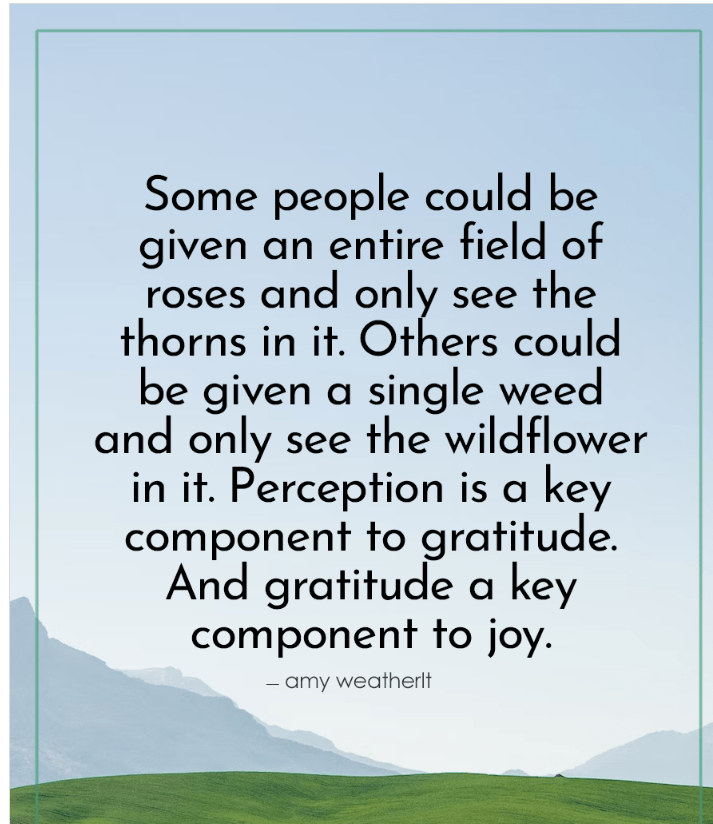
The Critical Need For Gratitude

There’s too much anger and finger-pointing in our world — so much blaming of others — especially these days.

Some people and communities are definitely more fortunate than others — I have many things that others do not.

If we all took a bit more time to practice gratitude — for both the big and little things — I’m pretty sure our world would be a better place.

That’s all.

Reality – More than the Facts

I’ve been doing a lot of recent wondering about the large amount of loud, social media noise that is crowding out more rationale thoughts and ideas. Part of my musing is how the education system should be responding to it in a way that builds a capacity in students to be able to discern truth from fiction — facts from opinions.

Let me go back a few years to my late teens and early 20s.

My undergraduate training in science provided me with an excellent set of tools to understand the world — to find reasons or explanations for a lot of things:

  • Why is the world’s climate changing so quickly?
  • What happens to our brain when we read?
  • What does trauma do to a person’s ability to learn?

Science uses The Scientific Method which, at its heart, is about ‘careful observation coupled with rigorous skepticism‘. Science uses a systematic process of working to disprove a current understanding about something, until the overwhelming evidence points to the truth — to an accepted fact.

I also love that science remains open to being wrong — that it challenges our assumptions and beliefs to ensure that bias is not part of the explanation.

REALITY IS MORE THAN FACTS

Yet, as I’ve grown in my career and throughout life, I’ve also come to understand that the ‘black and white’ world of science is not the complete answer. Reality is a combination of both the facts in front of us, and our personal experiences — experiences that help to create the context surrounding the facts.

Context: The conditions or situations that give meaning to an event.

Context adds the colour to the ‘black and white’ world of facts. The reality that we each experience lies enveloped in our own personal history and context.

  • How is one’s own personal history influencing the event of today?
  • What inherent biases are people bringing to what they ‘see’ or ‘hear’?

By taking the time to understand the ‘tapestry’ or colour of the situation you can start to forge a deeper understanding of what lies before you — helping you create a better solution to whatever problem or situation exists.

So, what do context and our own history have to do with public education? I’m glad you asked!

CRITICAL THINKING

If a goal of public education is to ‘have educated citizens who thrive in a changing world’, then preparing them to be critical consumers of their world is essential. Students need to be able to understand more than facts — they need to be able to examine the context in which they observe these facts and be aware that a person’s own history and perceptions may be affecting their understanding.

Critical Thinking is an absolute necessity for our students to be the citizens we need in a world filled with fake news, social media bias and opinions camouflaging as fact:

BC Education: Critical … thinking encompasses a set of abilities that students use to examine their own thinking and that of others. This involves making judgments based on reasoning, where students consider options, analyze options using specific criteria, and draw conclusions.

Sounds great. We want students to critically examine the information before them, ask relevant questions and move their understanding forward.

But, can we objectively measure Critical Thinking? Should we even try?

It’s not like you can easily put a number beside Critical Thinking to see if it improves over time. And, because something isn’t easily measured, it doesn’t mean it isn’t important — As examples, Character, Integrity and Honesty are three traits that I would argue are very important but aren’t easily measured.

Several cognitive experts set out to come to an agreed definition of Critical Thinking at a Learning and the Brain conference. And to save you the time of wondering … No agreement was reached. In fact, they disagreed on a number of issues surrounding the concept.

Curiosity Leads to Thinking Critically

But, here’s some of what they did agree on about Critical Thinking …

  • Although we can’t agree on a common definition, that doesn’t mean we shouldn’t prioritize Critical Thinking in education.
  • True critical thinkers aggressively question their own beliefs.
  • Teaching to think critically about something should be done as early as Kindergarten.
  • Asking questions about a topic is the necessary first step to a deeper understanding.
  • Be careful in the assumption that students are not already thinking critically, especially if we know that it can’t be easily measured.
  • Critical Thinking is important — but so are Creative Thinking, Interdisciplinary Thinking, Systems Thinking, and Fuzzy Logic to name a few.
  • So, don’t start a Critical Thinking Program in schools — that isn’t necessary or reasonable.
  • Instead, schools should focus on the importance of Curiosity being present. Being openly curious is the path to understanding.

FINAL THOUGHTS

Here are my top 5 take aways to help students be well prepared in distinguishing reality from what is not reality:

  1. Challenge assumptions – don’t assume what you’re observing is accurate,
  2. Watch out for opinions that may be misrepresented as facts – social media is flooded with this reality,
  3. Be reflective on your personal history and bias – it’s more influential on you than you may think,
  4. Be open to being wrong – I’m wrong a lot and admitting it actually helps me move forward, and
  5. Always be curious — because curiosity leads to deeper understanding!

That’s a pretty good list.

  • Science gives us a foundation;
  • Critical Thinking can lead to understanding context and its impact on the facts; and
  • Students become better, more informed citizens.

Important concepts in a world of uncertainty, hyperbole and unsubstantiated opinions. And there’s no shortage of that these days.