My 2024-2025 Reflections

There’s so much I am grateful for as Superintendent. But if I had to name just one thing that stands out, it’s this: I get to be part of a professional community that never stops striving to be better. Every day I’m surrounded by people who challenge and inspire me to grow — people who believe deeply in creating spaces where every learner can thrive. Together, we’re not just educators. We’re leaders. And we’re building something meaningful.

Like everywhere else, our district is affected by global issues. The global social and political realities of today are significant and impacting us in unexpected ways. In some of my previous posts I have commented on things such as the current political turmoil, economic uncertainty and social media biases — where we have seen the marginalizing of people because of their beliefs and personal preferences. I have blogged about the problems of racism, bigotry and hatred — because they are important topics for me — areas where we need conversation and action against them. As a school system, we have an obligation to combat these intolerances and be strong in our belief of being the places of kindness and understanding — the places where students feel welcomed, safe and included.

Tucker catching up on some critical down time

These are some of the current influences that are shaping my thinking and wonderings. With this as a backdrop, I’ve compiled a short list of 4 areas of personal reflection that I’d like to share — areas where I’ve spent some time — at work, on my drive home or perhaps walking Tucker:

  • Student Success
  • Artificial Intelligence & Education
  • Political and Economic Upheaval
  • A Personal Perspective

Student Success

We are 1/2 way through Strategic Plan 2022-2027 — and making some good progress in: Literacy; Indigenous Learner Success; Mental Health & Wellness; and Global Citizenship.

School Plans, Personal Growth Plans, Long-Range Facilities Plans, staff recruitment, the Information Technology Plan, budget planning and many other areas are all examples of how we align our efforts to the Strategic Plan, building on what we know works well as well as trying new things to make us better.

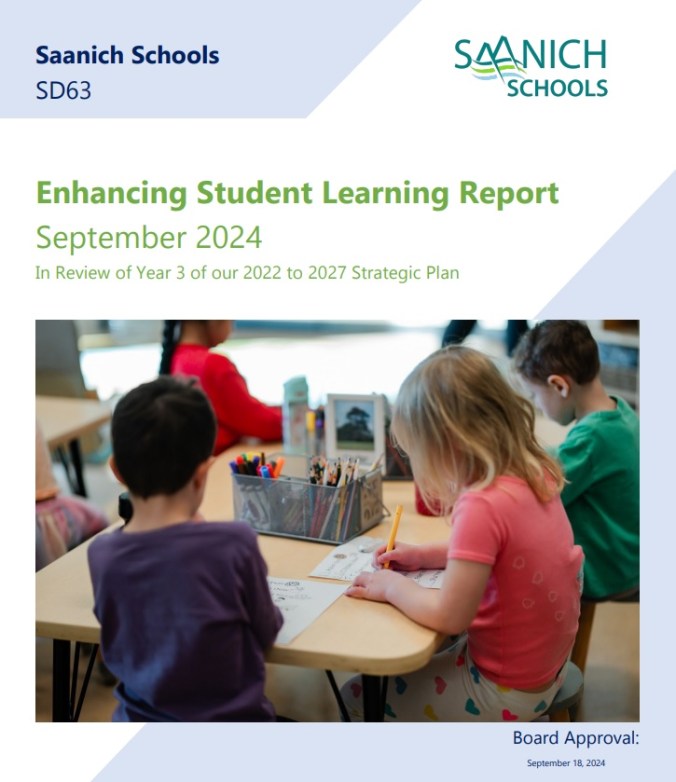
The Enhancing Student Learning Report (Sept 2024) provides a great overview of our successes and areas where we still need to focus.

Here are some sample results:

  • Overall student literacy rates are showing improvement including for students with complex learning needs. There is still a difference in literacy rates between Indigenous and non-Indigenous students, but the gap is narrowing.
  • Overall, students are feeling welcomed and safe at school. There has been a significant improvement of Indigenous students feeling a sense of belonging.
  • It is clear that having an adult with whom every child feels connected makes a tremendous difference in students’ sense of safety, as well as feeling valued for who they are in this world.
  • Graduation rates for all students continue to show a steady increase, with the biggest increase seen for the 6-year Indigenous student graduation rate increasing from 56% (2022-22) to 73% (2023-24).

These are just a few of the trends we are seeing. I encourage you to look over the entire Report when you have some time. While there is still much work to be done — especially as it relates to building equity — it is important to acknowledge the efforts our staff are providing in building successful learning opportunities for the students in our care.

Artificial Intelligence and Education

This is an exciting time to be in K-12 education.

In the words of a friend and colleague, “The AI you’re using today is the worst it’s ever going to be.” Being the most recent ‘disruptive technology‘, AI is altering the educational landscape — changing how we lesson plan, increasing accessibility to the curriculum, as well as how we assess student progress. It also provides opportunities within the business side of our system.

But, this newest of technologies also comes with questions and worries. We’re not ignoring these, but instead we’re building a foundation of understanding that is continually evolving alongside of the technology. By embracing the conversation, we have the best opportunity to leverage its possibilities, while being cognizant of ensuring its appropriate use.

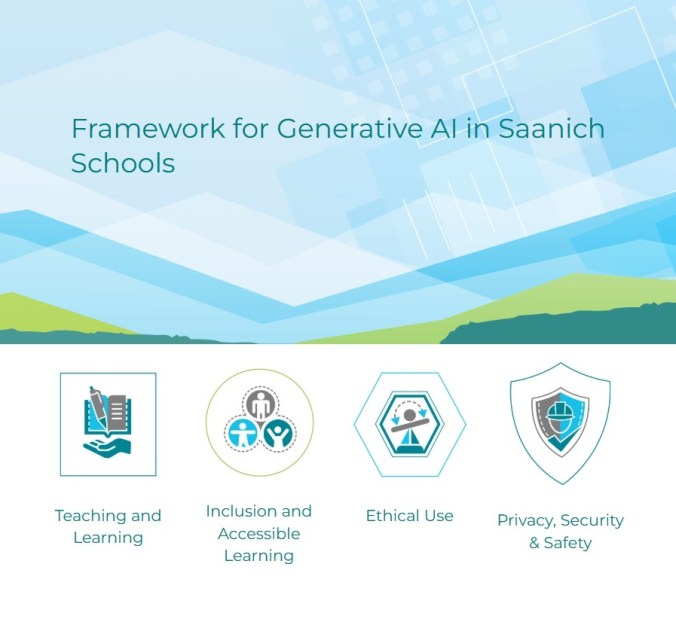
In Saanich, we produced a foundational document (Framework for Generative AI in Saanich Schools) that provides some of the ‘bumper pads or guiderails’ for AI in our schools. It is not the final word on how we use AI, but it does give us the foundation from which to build awareness and understanding, as well as increase our system capacity in capitalizing on this new, and evolving tool.

We hosted two staff GenAI Think Tanks this year as well as a virtual Parent Information Evening with 300 parents registered.

Our goal in these ongoing conversations is to share our current knowledge and progress, ask questions and continue our learning journey. We don’t have all of the answers. By asking questions and spending the time charting a path forward, we remain committed to being informed and progressive. We see the possibilities that AI can bring to our teaching and learning environments.

Stay tuned for continuing updates next year.

Political and Economic Upheaval

I have never intended for this blog to serve as a political platform—that has never been its purpose. Yet, remaining silent in the face of today’s turbulent political, social, and economic climate would be to ignore the wild uncertainty that surrounds us. This global instability is reverberating across all levels of governance — national, provincial, and local — leaving no community untouched, including here in British Columbia. Government budgets are in a state of flux, and school districts are not immune from the effects of this global uncertainty.

A Personal Perspective

Life is filled with moments that take your breath away and remind you there is a bigger picture . This past year, one of those moments was the birth of our granddaughter, Ophelia. What a pure bundle of joy! And, she just had her first birthday.

Baby Ophelia – 1 year old

Her brightness and inquisitiveness, the pure joy when she tastes new food, the giggles when you play peek-a-boo, and the screams of delight when you blow bubbles in her neck — they all put into perspective life’s priorities.

While there are many pressure points in our professional lives — in the end, what matters most are the people.

It is Ophelia and others like her who bring the greatest meaning to our lives and our priorities — both personally and professionally.

See you in September!

For those of you returning next year, I look forward to connecting with you again in our schools and district office. And, if you are off to new adventures thank you for being part of our community of learners. I wish you well.

Thank you to everyone who has entered my world this year — you have made an impact and a difference. I wish all of you a summer of rejuvenation, and opportunities to do the things that may get pushed aside during the busy school year.

Dave

(This post was written without the support of Artificial Intelligence.)

Reality – More than the Facts

I’ve been doing a lot of recent wondering about the large amount of loud, social media noise that is crowding out more rationale thoughts and ideas. Part of my musing is how the education system should be responding to it in a way that builds a capacity in students to be able to discern truth from fiction — facts from opinions.

Let me go back a few years to my late teens and early 20s.

My undergraduate training in science provided me with an excellent set of tools to understand the world — to find reasons or explanations for a lot of things:

  • Why is the world’s climate changing so quickly?
  • What happens to our brain when we read?
  • What does trauma do to a person’s ability to learn?

Science uses The Scientific Method which, at its heart, is about ‘careful observation coupled with rigorous skepticism‘. Science uses a systematic process of working to disprove a current understanding about something, until the overwhelming evidence points to the truth — to an accepted fact.

I also love that science remains open to being wrong — that it challenges our assumptions and beliefs to ensure that bias is not part of the explanation.

REALITY IS MORE THAN FACTS

Yet, as I’ve grown in my career and throughout life, I’ve also come to understand that the ‘black and white’ world of science is not the complete answer. Reality is a combination of both the facts in front of us, and our personal experiences — experiences that help to create the context surrounding the facts.

Context: The conditions or situations that give meaning to an event.

Context adds the colour to the ‘black and white’ world of facts. The reality that we each experience lies enveloped in our own personal history and context.

  • How is one’s own personal history influencing the event of today?
  • What inherent biases are people bringing to what they ‘see’ or ‘hear’?

By taking the time to understand the ‘tapestry’ or colour of the situation you can start to forge a deeper understanding of what lies before you — helping you create a better solution to whatever problem or situation exists.

So, what do context and our own history have to do with public education? I’m glad you asked!

CRITICAL THINKING

If a goal of public education is to ‘have educated citizens who thrive in a changing world’, then preparing them to be critical consumers of their world is essential. Students need to be able to understand more than facts — they need to be able to examine the context in which they observe these facts and be aware that a person’s own history and perceptions may be affecting their understanding.

Critical Thinking is an absolute necessity for our students to be the citizens we need in a world filled with fake news, social media bias and opinions camouflaging as fact:

BC Education: Critical … thinking encompasses a set of abilities that students use to examine their own thinking and that of others. This involves making judgments based on reasoning, where students consider options, analyze options using specific criteria, and draw conclusions.

Sounds great. We want students to critically examine the information before them, ask relevant questions and move their understanding forward.

But, can we objectively measure Critical Thinking? Should we even try?

It’s not like you can easily put a number beside Critical Thinking to see if it improves over time. And, because something isn’t easily measured, it doesn’t mean it isn’t important — As examples, Character, Integrity and Honesty are three traits that I would argue are very important but aren’t easily measured.

Several cognitive experts set out to come to an agreed definition of Critical Thinking at a Learning and the Brain conference. And to save you the time of wondering … No agreement was reached. In fact, they disagreed on a number of issues surrounding the concept.

Curiosity Leads to Thinking Critically

But, here’s some of what they did agree on about Critical Thinking …

  • Although we can’t agree on a common definition, that doesn’t mean we shouldn’t prioritize Critical Thinking in education.
  • True critical thinkers aggressively question their own beliefs.
  • Teaching to think critically about something should be done as early as Kindergarten.
  • Asking questions about a topic is the necessary first step to a deeper understanding.
  • Be careful in the assumption that students are not already thinking critically, especially if we know that it can’t be easily measured.
  • Critical Thinking is important — but so are Creative Thinking, Interdisciplinary Thinking, Systems Thinking, and Fuzzy Logic to name a few.
  • So, don’t start a Critical Thinking Program in schools — that isn’t necessary or reasonable.
  • Instead, schools should focus on the importance of Curiosity being present. Being openly curious is the path to understanding.

FINAL THOUGHTS

Here are my top 5 take aways to help students be well prepared in distinguishing reality from what is not reality:

  1. Challenge assumptions – don’t assume what you’re observing is accurate,
  2. Watch out for opinions that may be misrepresented as facts – social media is flooded with this reality,
  3. Be reflective on your personal history and bias – it’s more influential on you than you may think,
  4. Be open to being wrong – I’m wrong a lot and admitting it actually helps me move forward, and
  5. Always be curious — because curiosity leads to deeper understanding!

That’s a pretty good list.

  • Science gives us a foundation;
  • Critical Thinking can lead to understanding context and its impact on the facts; and
  • Students become better, more informed citizens.

Important concepts in a world of uncertainty, hyperbole and unsubstantiated opinions. And there’s no shortage of that these days.

The Teenage Brain: A New Perspective

The teenage years have always been a big adventure — a time of seemingly boundless energy and enthusiasm. There has also been a tendency to sometimes label the teenager as impulsive and reckless — risk-takers who lack the decision-making abilities of adults.

The Wonderfully Complex and Morphing Brain of a Teenager

This characterization is misleading as recent neuroscience research is flipping this narrative on its head.

In an article by Zara Abrams, “What neuroscience tells us about the teenage brain” (2022), it turns out that the teenage brain is not just a bundle of chaos heading towards risky behaviour, but a powerhouse of neural potential and adaptability.

Here are some recent findings …

One of the most fascinating aspects of the teenage brain is its heightened sensitivity to rewards. This trait is driven by increased neural activity in an area known as the ventral striatum, a part of the brain that is involved in decision making, motor control, emotion, habit formation, and reward. This area has long been linked to risky behaviors like substance use, however, in the right environment this same sensitivity can lead to positive outcomes, such as increased motivation and social engagement. Not surprisingly, when teens are exposed to positive environments, their resulting actions tend to point in directions that can lead to some pretty amazing things.

There is building, brain-based evidence to support this.

Here are three brief descriptions of some amazing youth and the impacts they made in their teens:

  1. Autumn Peltier
    • At just 13 years of age, Canadian Indigenous rights activist Autumn Peltier addressed the United Nations General Assembly, urging them to recognize the importance of water protection. In 2019 and at the young age of 15, Autumn Peltier was named the chief water commissioner for the Anishinabek Nation, a group representing 40 First Nations across Ontario.
  2. Malala Yousafzai
    • As a child, Malala Yousafzai went to her dad’s school in Pakistan to be one of the few girls to get an education. One day as she was on her way to school, she was shot by a gunman simply because she was a student. Surviving this horrific event, Malala has become a passionate, global advocate for women’s educational rights.
  3. Greta Thunberg
    • In 2019, this Swedish teen was named ‘Person of the Year’ by Time Magazine in recognition of her work as a climate change activist: “We can’t just continue living as if there was no tomorrow, because there is a tomorrow.”
Autumn Peltier

Today, researchers are using sophisticated methods to study the teenage brain including conducting longitudinal studies. Instead of just comparing different age groups, researchers are following the same individuals over time. This approach is providing an even clearer picture of how the teenage brain develops and changes during adolescence.

The teenage brain is more malleable than we had thought.

This malleability or neuroplasticity means that teens are particularly adept at learning and adapting to new situations — all while their brains are undergoing a significant re-wiring — where their neural network is reducing grey matter (the cell bodies and connections between nerves) while increasing white matter (the insulated neural highways that speed information within the brain and throughout the body).

Malala Yousafzai

Teens are living their complex lives while their brains are making neural changes affecting their thinking, reasoning and actions. And … these changes are not uniform. This variability makes adolescence a unique and critical period, where it can lead to both positive and negative teen behavior.

This is where parents and educators play a pivotal role.

We cannot easily change certain environmental conditions like socio-economic status or even where we live, but we CAN influence an environmental condition that is likely even more important — our relationships with teens.

Greta Thunberg

And because of this, parents and educators play a crucial role in shaping the teenage brain. Positive reinforcement and supportive relationships can steer teens towards healthier behaviors. We can’t always control teen life stressors, but we can model how we react to them and also how we support teens. Understanding this developing science behind teenager brain development can only help influential adults such as parents and educators provide the best possible guidance for youth.

Despite these advances in research, there’s still much to learn about the teenage brain — an incredible, morphing marvel of nature.

So, the next time you see a teenager remember – their brain is not just a work in progress, but a potential masterpiece in the making in which we can all play a role.