When I look back over almost forty years in public education, what strikes me most is not simply what has changed … but why.
Education has steadily moved away from being a place where we simply impart content, toward a broader and more human-centered vision — one that recognizes learning as deeply connected to a person’s identity, well-being, and belonging. The story of education in BC is no longer just about mastering the core mandates of reading, writing, and arithmetic — it is about preparing young people for a complex, uncertain, and interconnected world that incorporates these important skills.

For much of the late twentieth century, schooling was measured by coverage — how much content could be delivered in 13 years and how efficiently it could be assessed. Rote memorization and standardized testing were the norm and were used to measure school success. Knowledge was something students received, often passively, and success was frequently defined by one-size-fits-all benchmarks.
Over time, however, we began asking better questions.
- What does it mean to understand rather than memorize?
- How does student learning lead to future readiness?
These shifts laid the foundation for today’s competency-based approach — one focused on meaningful application of content and knowledge rather than just the sheer volume of information being taught.
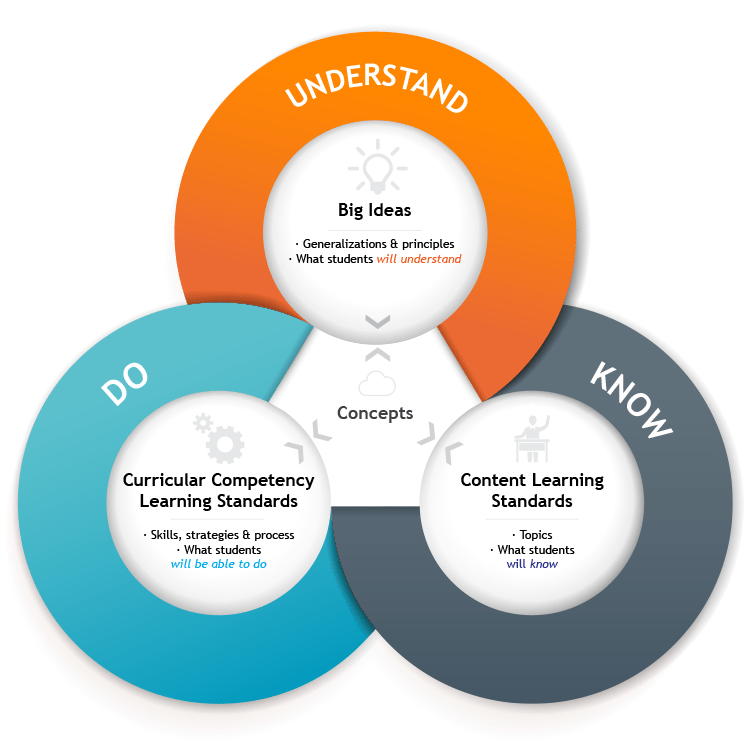
The reinvigorated BC curriculum represents this shift.
While content still matters — it is no longer the end goal. Instead, content serves as the vehicle through which students develop the capacities they need for life beyond school — things like critical and creative thinking, communication, collaboration, and personal and social responsibility. The curriculum’s emphasis on knowing, doing, and understanding reflects a recognition that education must prepare learners not just to recall information, but to navigate ambiguity, solve problems, and contribute thoughtfully to their communities.
Alongside this curricular shift has come a growing respect for student voice, choice, and personalized pathways.
There is now greater acknowledgment that learners arrive with different strengths, interests, cultures, and aspirations. Student-centered learning is not about lowering expectations — it is about raising relevance. When young people see themselves in their learning — and have agency in shaping it — they are far more likely to engage deeply and persist through the inevitable challenges that come along with it.
Perhaps one of the most profound changes over the past four decades has been the expansion of inclusion. There is greater awareness of diverse learning needs, disabilities, neurodiversity, cultural backgrounds, and systemic inequities. While the work is far from complete, the moral center of the system has shifted toward equity, dignity, and access — recognizing that fairness does not mean sameness.

As part of this shift to greater inclusion, there has also been a powerful and necessary re-centering of Indigenous perspectives, reconciliation, and local context. Schools are moving away from a singular, colonial narrative toward a more honest and inclusive understanding of history, land, and relationships. This work challenges educators and students to think beyond a western, colonial narrative to one that honours the significant knowledge and history of local First Nations communities and other Indigenous groups.
Schools today also attend far more deliberately to mental health, well-being, and social-emotional learning than in the past — a nod to a greater sense of inclusion as well. We now understand that learning cannot be separated from how students feel, the relationships they experience, and the sense of safety they carry with them. Supporting the whole child is no longer seen as a distraction from academic learning, but as the foundation that makes it possible.
Technology, once a peripheral add-on, now sits at the heart of learning, communication, and administration. From digital literacy and online collaboration to data-informed decision-making, technology has reshaped how schools function and how students learn. Artificial Intelligence is the next thing in technology — a tool so powerful, it has the potential to reshape not only the learning side of what we do, but the business side of how we do it. Importantly, this technology shift has reinforced the need to maintain and focus on students’ critical thinking — not just how to use tools, but how to evaluate information, question sources, and engage responsibly in digital spaces. Technology is amplifying the why behind learning rather than replacing it.
Public education in BC has come a long way over the past four decades.
Its mandate has expanded, its values have deepened, and its purpose has become clearer. The enduring question — the real Power of Why — is not whether schools should focus on basics or broader skills, but how they can hold both in balance. In doing so, education remains what it was always meant to be — a promise to young people that they will be seen, supported, and prepared for the lives they are yet to imagine.
The Why of public education is stronger than it’s ever been — more relevant in a world that needs compassion, understanding and inclusion.