Servant Leadership

I first heard about the concept of Servant Leadership several years ago and appreciated its main ideas:
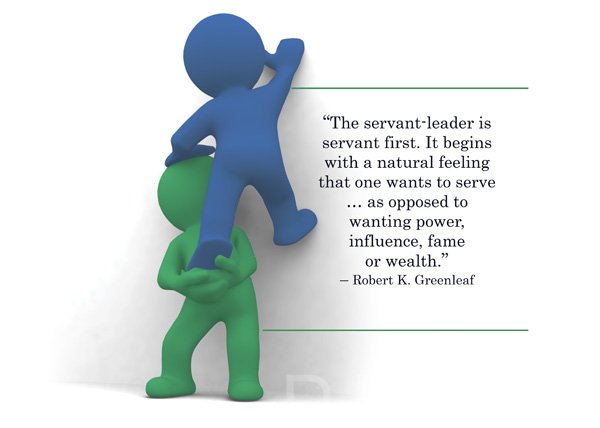
  • A servant leader is someone who “shares power, puts the needs of the employees first and helps people develop and perform as highly as possible. Instead of the people working to serve the leader, the leader exists to serve the people.”

It’s really about framing one’s MINDSET about how you relate to others in the workplace — about how one goes about their day — in other words, how a leader thinks, speaks and acts to support the people in the organization.

When I contextualize it for myself, I picture it being about my words and my actions that build the confidence, abilities and leadership in others. It’s also an area where I continually think of ways to become better.

Being part of a smaller school district, it is imperative that I lead in areas that build capacity — both in individuals and in our district. It is capacity that helps to build the redundancies in skills and knowledge which enable our district to withstand things like sudden illnesses or departures.

(More on Page 2)

Social Media and Reality

This blog is about Social Media. But, before I delve into that topic I’d like to start by talking about something else — PERCEPTION and it’s incredible importance in our daily lives and our reality.

Perception overrules Facts every time. Facts represent the truth, but perception represents our actual reality. We remember facts because we process them through our senses (touch, taste, smell, sight and hearing). We filter them through these senses and, by doing so, actually interpret them from our past experiences — every time. And while we may want to believe that we are not being judgmental — that we are always being objective in our thinking and conversation — we are not. Our ‘objectivity’ is actually subjective in nature because we have created meaning out of what we have observed. This meaning is created when we link our present experiences to the previous — our past understandings, emotions and feelings.

Personal lens: The filter that we all use that interprets our environment. It shapes our perception of events through our own experiences, emotions and beliefs.

It is our personal lens that creates our unique reality — our perception of the world around us. It is why two people can ‘see’ the same thing yet come away with two completely different understandings of what they ‘saw’. For example, courts rely less on eye witnesses than they do on things like DNA evidence, because DNA doesn’t require a filter to exist.

People are shaped by their perceptions and are frankly not that reliable in their objectivity.

Going Down The Rabbit Hole

Lately, I’m finding myself using the metaphor of being careful to not to fall ‘Down the Rabbit Hole‘. And while I’m not a particular fan of Alice in Wonderland, I do appreciate the symbolism of the story.

For me, the Rabbit Hole represents a warning. A warning for myself (and others) to not be pulled into that space of distraction where others may want to take you.

Alice and the Rabbit Hole

What is a Rabbit Hole? Its reference goes back to Alice being attracted to the hole in the ground and then falling head over heals into a new world of amazement and distraction.

In the real world, Rabbit Holes are sometimes referenced when we see something that pulls us away from the task at hand. I reference the concept when I see things such as questions or statements that may even seem somewhat related to the topic, but in reality, they are meant to pull us away from the important conversation or task in front of us.