There is a constant tension in leadership. There are moments in every leader’s journey when we’re faced with a choice — Do we say the hard thing, or do we stay silent to keep the peace?
It’s tempting to choose what appears to be the ‘easier’ route. After all, we’re in the business of nurturing, supporting, and building community — ‘rocking the boat’ would appear to be the opposite of that. And, we all want to be viewed as nice.
But the truth is — being ‘nice‘ isn’t the same as being ‘kind‘.
Let me explain.
As leaders, we can confuse niceness with goodness. We all desire to be ‘good’, and to do that we can also think we just need to be ‘nice’ all the time. We avoid the difficult conversations because we don’t want to hurt feelings or be seen as harsh.
But niceness, when it avoids the truth, can erode the trust we need as an organization. Kindness, on the other hand, is rooted in respect which can build and strengthen trust. It’s the courage to speak honestly, even when it’s uncomfortable — because we care enough to want better for each other and for our organization.
Being a kind leader means holding people accountable with compassion. It means addressing the colleague who consistently misses deadlines, not to shame them, but to support their growth. It means naming the tension in a meeting, not to create conflict, but to clear the air and move forward with integrity. And, it may sometimes mean making a difficult decision.
Over my 37 years in public education, I’ve learned that the most honouring thing we can do for our staff is to be clear and consistent. Clarity is kindness. When we avoid the awkward conversation — the hard conversation — we leave people guessing. We create a culture of uncertainty, where assumptions fill the silence. But, when we speak with honesty and empathy, when we work to address the issues, we build a workplace where people feel seen, respected, and safe.
Speaking with honesty doesn’t mean we abandon warmth or empathy.
Quite the opposite. Kindness is deeply relational.
Kindness in Leadership: The practice of demonstrating empathy, compassion and consideration even when making difficult decisions. Kindness in leadership is not about being weak or compromising standards, but rather about balancing firmness with care, and understanding.
Kindness is about showing up with humanity, even when the message is hard. It’s about saying, “I believe in you enough to have this conversation”.
In our schools, we talk about modeling the culture we want to see in our students. If we want them to grow into courageous, respectful and engaged citizens, we must show them what that looks like in adult relationships. This starts with us — leaders who are willing to be kind, not just nice — leaders who have the hard conversations because it’s not only the right thing to do, but also the kind and respectful thing to do.
So, the next time you hesitate before a tough conversation, ask yourself this question:‘Am I avoiding this to be liked, or am I leading with kindness and respect?‘
Kindness isn’t always comfortable — but it’s always worth it. It’s always the correct path.
Building an organizational culture where truth and care walk hand-in-hand is what makes us stronger and on our desired trajectory — to grow and get better. It’s a leadership journey where we realize that feedback is a gift, not a threat — where we honour each other enough to be real.
Because in the end … kindness builds trust. And trust builds everything else.
There’s so much I am grateful for as Superintendent. But if I had to name just one thing that stands out, it’s this: I get to be part of a professional community that never stops striving to be better. Every day I’m surrounded by people who challenge and inspire me to grow — people who believe deeply in creating spaces where every learner can thrive. Together, we’re not just educators. We’re leaders. And we’re building something meaningful.
Like everywhere else, our district is affected by global issues. The global social and political realities of today are significant and impacting us in unexpected ways. In some of my previous posts I have commented on things such as the current political turmoil, economic uncertainty and social media biases — where we have seen the marginalizing of people because of their beliefs and personal preferences. I have blogged about the problems of racism, bigotry and hatred — because they are important topics for me — areas where we need conversation and action against them. As a school system, we have an obligation to combat these intolerances and be strong in our belief of being the places of kindness and understanding — the places where students feel welcomed, safe and included.
Tucker catching up on some critical down time
These are some of the current influences that are shaping my thinking and wonderings. With this as a backdrop, I’ve compiled a short list of 4 areas of personal reflection that I’d like to share — areas where I’ve spent some time — at work, on my drive home or perhaps walking Tucker:
Student Success
Artificial Intelligence & Education
Political and Economic Upheaval
A Personal Perspective
Student Success
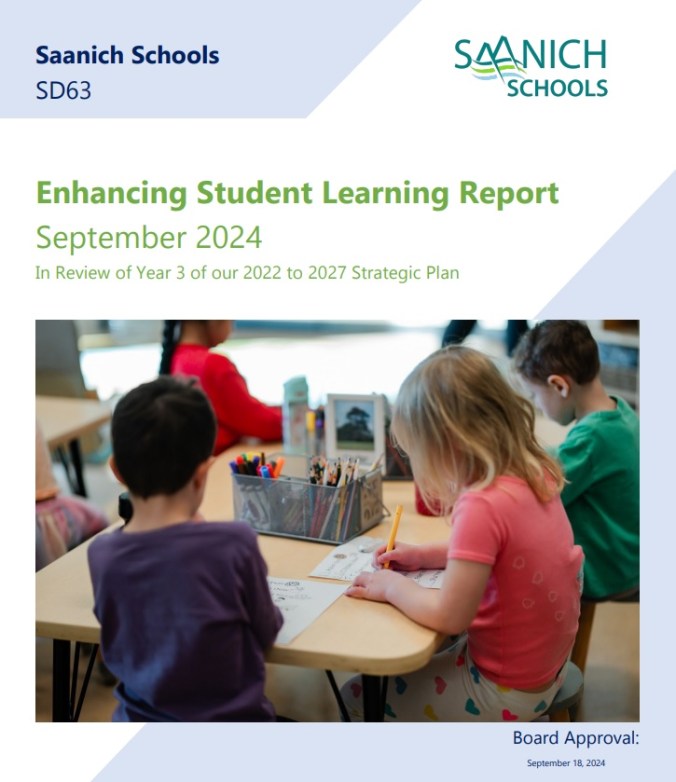
We are 1/2 way throughStrategic Plan 2022-2027 — and making some good progress in:Literacy; Indigenous Learner Success; Mental Health & Wellness; and Global Citizenship.
School Plans, Personal Growth Plans, Long-Range Facilities Plans, staff recruitment, the Information Technology Plan, budget planning and many other areas are all examples of how we align our efforts to the Strategic Plan, building on what we know works well as well as trying new things to make us better.
Overall student literacy rates are showing improvement including for students with complex learning needs. There is still a difference in literacy rates between Indigenous and non-Indigenous students, but the gap is narrowing.
Overall, students are feeling welcomed and safe at school. There has been a significant improvement of Indigenous students feeling a sense of belonging.
It is clear that having an adult with whom every child feels connected makes a tremendous difference in students’ sense of safety, as well as feeling valued for who they are in this world.
Graduation rates for all students continue to show a steady increase, with the biggest increase seen for the 6-year Indigenous student graduation rate increasing from 56% (2022-22) to 73% (2023-24).
These are just a few of the trends we are seeing. I encourage you to look over the entire Reportwhen you have some time. While there is still much work to be done — especially as it relates to building equity — it is important to acknowledge the efforts our staff are providing in building successful learning opportunities for the students in our care.
Artificial Intelligence and Education
This is an exciting time to be in K-12 education.
In the words of a friend and colleague, “The AI you’re using today is the worst it’s ever going to be.” Being the most recent ‘disruptive technology‘, AI is altering the educational landscape — changing how we lesson plan, increasing accessibility to the curriculum, as well as how we assess student progress. It also provides opportunities within the business side of our system.
But, this newest of technologies also comes with questions and worries. We’re not ignoring these, but instead we’re building a foundation of understanding that is continually evolving alongside of the technology. By embracing the conversation, we have the best opportunity to leverage its possibilities, while being cognizant of ensuring its appropriate use.
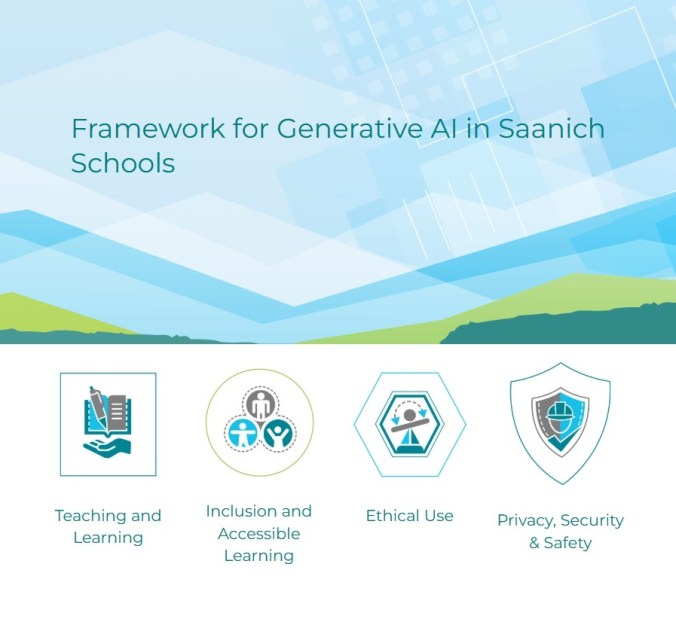
In Saanich, we produced a foundational document (Framework for Generative AI in Saanich Schools) that provides some of the ‘bumper pads or guiderails’ for AI in our schools. It is not the final word on how we use AI, but it does give us the foundation from which to build awareness and understanding, as well as increase our system capacity in capitalizing on this new, and evolving tool.
We hosted two staff GenAI Think Tanks this year as well as a virtual Parent Information Evening with 300 parents registered.
Our goal in these ongoing conversations is to share our current knowledge and progress, ask questions and continue our learning journey. We don’t have all of the answers. By asking questions and spending the time charting a path forward, we remain committed to being informed and progressive. We see the possibilities that AI can bring to our teaching and learning environments.
Stay tuned for continuing updates next year.
Political and Economic Upheaval
I have never intended for this blog to serve as a political platform—that has never been its purpose. Yet, remaining silent in the face of today’s turbulent political, social, and economic climate would be to ignore the wild uncertainty that surrounds us. This global instability is reverberating across all levels of governance — national, provincial, and local — leaving no community untouched, including here in British Columbia. Government budgets are in a state of flux, and school districts are not immune from the effects of this global uncertainty.
A Personal Perspective
Life is filled with moments that take your breath away and remind you there is a bigger picture . This past year, one of those moments was the birth of our granddaughter, Ophelia. What a pure bundle of joy! And, she just had her first birthday.
Baby Ophelia – 1 year old
Her brightness and inquisitiveness, the pure joy when she tastes new food, the giggles when you play peek-a-boo, and the screams of delight when you blow bubbles in her neck — they all put into perspective life’s priorities.
While there are many pressure points in our professional lives — in the end, what matters most are the people.
It is Ophelia and others like her who bring the greatest meaning to our lives and our priorities — both personally and professionally.
See you in September!
For those of you returning next year, I look forward to connecting with you again in our schools and district office. And, if you are off to new adventures thank you for being part of our community of learners. I wish you well.
Thank you to everyone who has entered my world this year — you have made an impact and a difference. I wish all of you a summer of rejuvenation, and opportunities to do the things that may get pushed aside during the busy school year.
Dave
(This post was written without the support of Artificial Intelligence.)
I’ve seen commentary that people who are wealthy must be great leaders. That is typically not my ‘go to’ as I’ve seen some wealthy people who aren’t the most honourable. Having lots of money doesn’t automatically translate into exceptional leadership. Instead, I look for leaders with exceptional personal values — things like compassion, transparency, consistency and honesty. This being said, there are people in this world who are both wealthy and of high moral character.
Warren Buffett is one of those people.
When he speaks and writes about his values, they transcend the boundaries of finance. The following is a great example:
When one talks about integrity, especially when hiring for leadership positions, it can sometimes be an afterthought for some organizations — and that is a huge mistake.
Integrity in our leaders is what builds trust, and trust is the cornerstone upon which successful organizations thrive. Integrity, intelligence and energy are a forceful combination that can help drive organizational success. However, without integrity, a leader who has both intelligence and energy can be dangerous and even destructive.
Leaders need to possess a strong ethical compass to ensure that their decisions and actions are guided by principles that foster respect and belief in their values.
I have talked about this importance of integrity before, when I discussed the critical importance of CHARACTER (Leadership, Character and Congruence – Oct 2023). Integrity and character are intertwined — they both represent that same intangible, and critical quality that helps build long-term organizational success.
The other two traits that Buffet discusses — intelligence and energy — are undoubtedly valuable in a leader. Intelligence allows for strategic thinking and problem-solving, while energy drives motivation and productivity. However, without integrity, these other two qualities lead to manipulation and dishonesty. A leader who lacks integrity often uses their intelligence to deceive and their high energy levels to pursue selfish goals, ultimately harming the organization and its people.
Buffett reminds us that leadership is not merely about achieving results, but about how those results are achieved. Leaders with integrity create an environment where employees feel valued and respected, leading to higher morale and productivity, and it fosters a culture of transparency and accountability essential for long-term success.
This creates a ripple effect, encouraging employees to act with their own honesty and responsibility.
Effective Leaders lead with Integrity
In today’s fast-paced environment, the temptation to prioritize short-term wins over long-term values can be tempting, yet disastrous. Organizations must look at future leaders beyond their resumes and job qualifications, to assess their character and values. This involves evaluating their past behavior, decision-making processes, and their commitment to ethical principles.
Do they resolve situations by holding true to the values they espouse?
Are they a person who handles difficulties with grace, dignity and accountability?
Are they honourable when no one is looking?
Leadership in education is about the long game. You build productive change by living true to one’s values. Your personal and consistent commitment to them is the game changer for positive results. Leaders who uphold this principle are better equipped to make decisions that benefit their organizations in the long run, even if it means sacrificing immediate rewards.
Furthermore, integrity in leadership is not just about avoiding unethical behavior; it is about actively promoting ethical practices. Leaders with integrity lead by example, demonstrating the importance of honesty, fairness, and respect in all aspects of their work.
So, while intelligence and energy are critically important, they must be grounded in a strong ethical foundation to be truly effective. When hiring leaders ensure that integrity comes first, second and third. Only then, will the leader’s intelligence and energy push your organization to greater heights.
(NOTE: This post was created with the assistance of AI on the Warren Buffet quote, however, there was significant input in the final product from the author’s own beliefs and content.)






 The Power of Why