As educators, we often find ourselves talking about the visible things:
- Programs
- Resources
- Technology
- Learning spaces
These are the aspects of schooling that people notice first. They are tangible. Easy to discuss. Easy to photograph. Easy to quantify.
Yet, the most important aspects of education are often invisible:
- Trust
- Belonging
- Purpose
- Hope
You will not find many of these things neatly organized in a budget document. They do not fit comfortably into spreadsheets, dashboards, purchase orders, or annual reports.
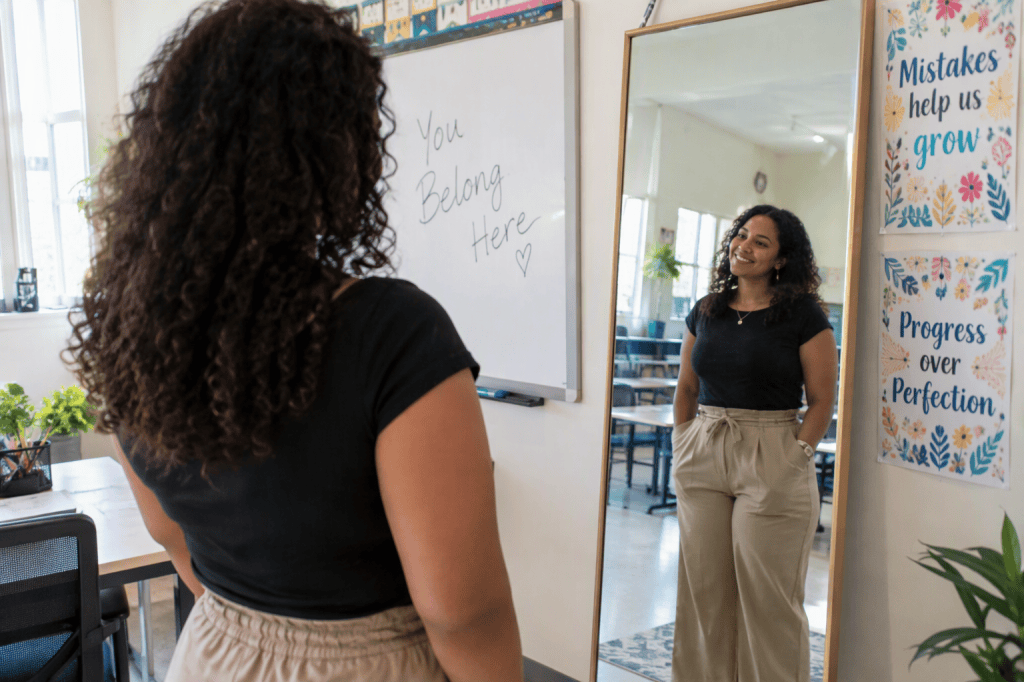
And yet they shape everything.
When I think about the three school districts I have been fortunate to be a part of over my career, the schools that stand out as leaders are never defined by their architecture, the technology and resources they adopted, or the initiatives they launched.
They are defined by how they made people feel. They are the places where students felt seen. Where staff felt valued. Where families felt welcomed. Where people knew they belonged.
In a recent blog post, I reflected on how public education has evolved over the past forty years. I wrote that education has moved beyond simply delivering content toward “a broader and more human-centered vision” that recognizes learning as deeply connected to identity, well-being, and belonging. That idea continues to resonate with me because it speaks to a fundamental truth — learning is a human endeavour before it is an academic one.
Consider any learning environment where students are thriving. What do you notice?
- You may see engaging instruction.
- You may observe innovative learning spaces.
- You may notice purposeful use of technology.
But if you look a little deeper, you will often discover something even more significant.
You will find students who feel known, adults who care, and relationships that are regularly and consistently reinforced which builds trust and respect. You will find a culture where people feel safe enough to take risks, ask questions, make mistakes, and grow. People flourish when they feel connected and safe.
Everything else is secondary.
This is one of the reasons that meaningful educational change can be so challenging.
- It is relatively easy to purchase resources. It is much harder to build a positive culture.
- It is relatively easy to launch an initiative. It is much harder to sustain a shared sense of purpose and belonging.
And yet those deeper elements are where the real work lives.
As I reflected in my year-end blog this past June, one of the strongest themes emerging across our district was student belonging. Not because it was a stand-alone initiative, but because we increasingly understand that belonging is foundational to everything else we hope to achieve. Academic growth matters. Literacy matters. Numeracy matters. Career readiness matters. But all of these outcomes become more attainable when students feel connected, supported, and challenged.
Purpose and belonging are not nice additions to learning. They are the foundations for learning.
Throughout this blog, I often return to the idea of “why.” The reason is simple. When we become disconnected from our purpose, it becomes easy to focus exclusively on the mechanics of education rather than its deeper mission.
The question is never simply, “What are we doing?” The more important question is, “Why are we doing it?” The answer to that question shapes every decision that follows.
It influences how we design schools — how we allocate resources — how we support students — how we work together.

It influences whether our efforts become transformational or merely transactional.
When I wrote recently about Truth and Reconciliation, I reflected on the unique role that schools play in bringing together young people from diverse backgrounds, experiences, and perspectives. Schools remain one of the few places in our society where an entire generation learns alongside one another. That reality is powerful. It reminds us that education is not simply about preparing students for employment. It is about preparing them to participate meaningfully in communities and contribute to a better future for all of us.
In other words, it is about helping young people find both belonging and purpose.
As I look back on the many innovations that have moved through education over the years, I continue to arrive at the same conclusion. Most successful initiatives are not successful because of what they introduce. They are successful because of what they reinforce – connection, agency, curiosity and human potential.
Because in the end, the most important work in education has never been the visible work. It is the invisible work of helping people feel that they belong, that they matter, and that their lives have purpose.
And that work changes everything.


Belonging is so important and is also essential in academics as well as a grounding for learning. To belong to a community of readers, belonging as a person as well as a participant in the skills necessary to be a reader. When children have challenges the importance of both cannot be underestimated; keeping the person emotionally safe while strengthening a skill set is essential. For example, undergirding the identity of children so they see themselves as readers is important, so remembering to highlight the learning of each skill is as important for the teacher to celebrate as is identification of the next skill to be learned. Motivation for a child to want to belong to a community of readers, mathematicians, artists, geographers, historians, craftspersons etc., is at the heart of learning each subject.
LikeLike